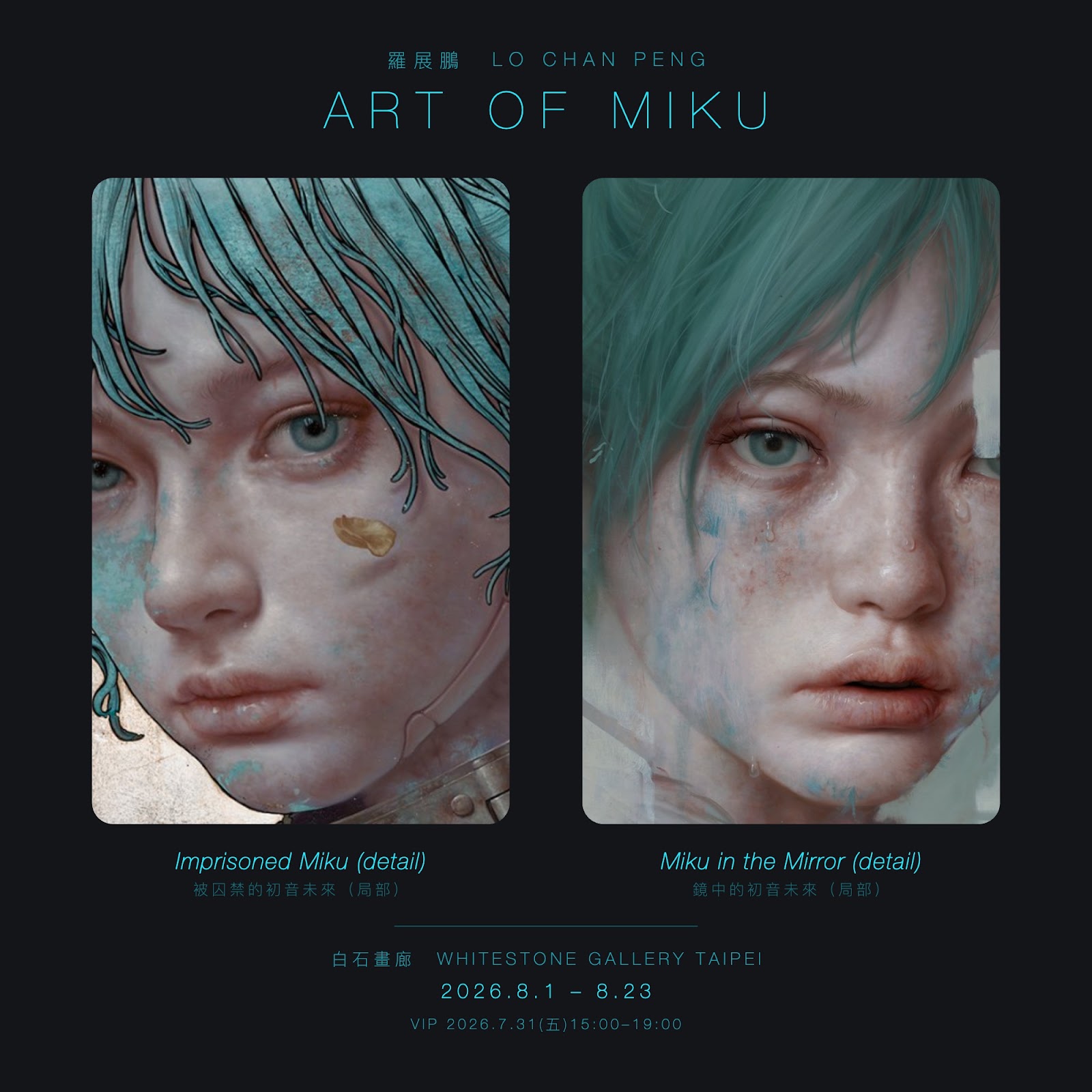
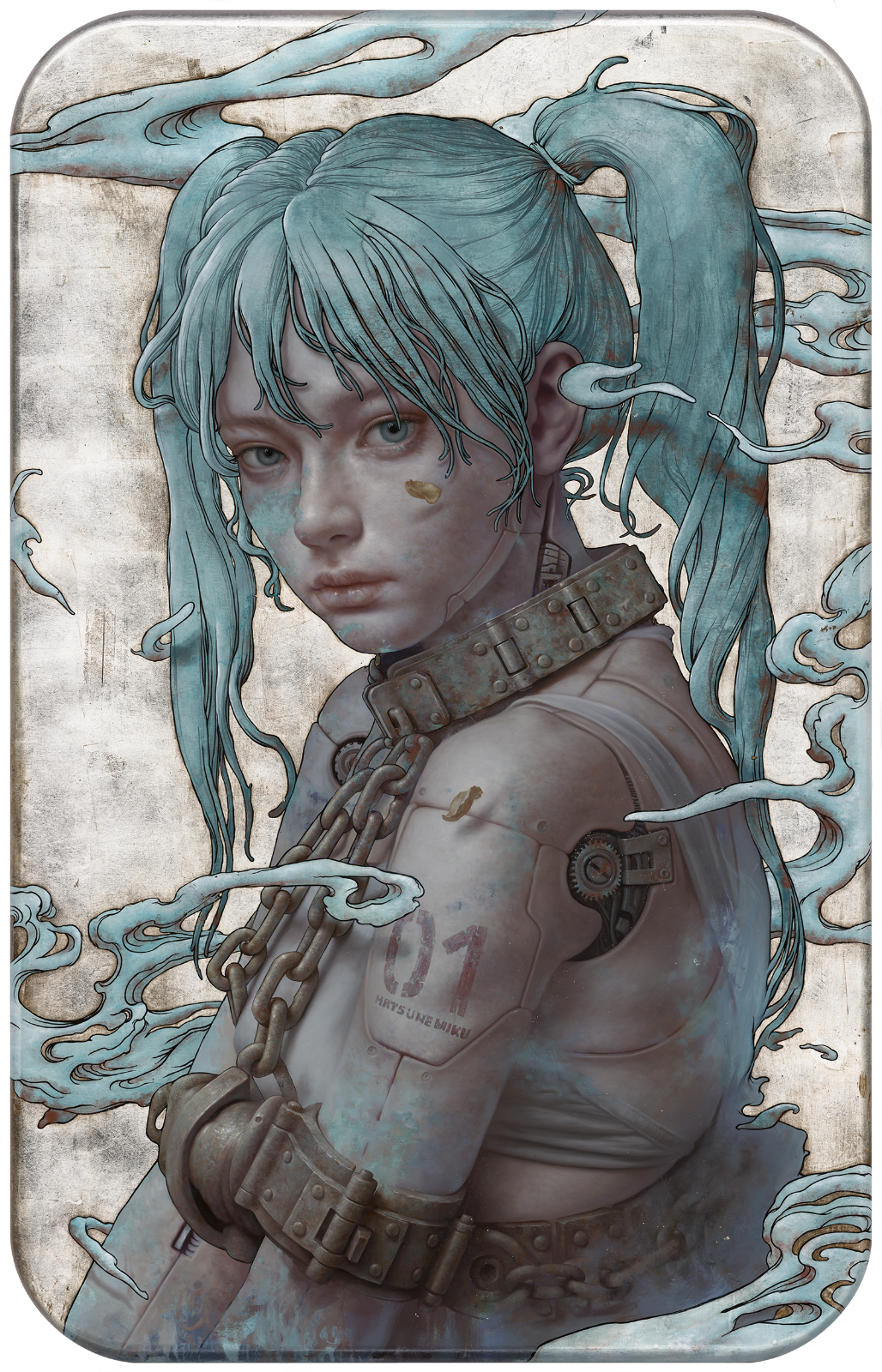
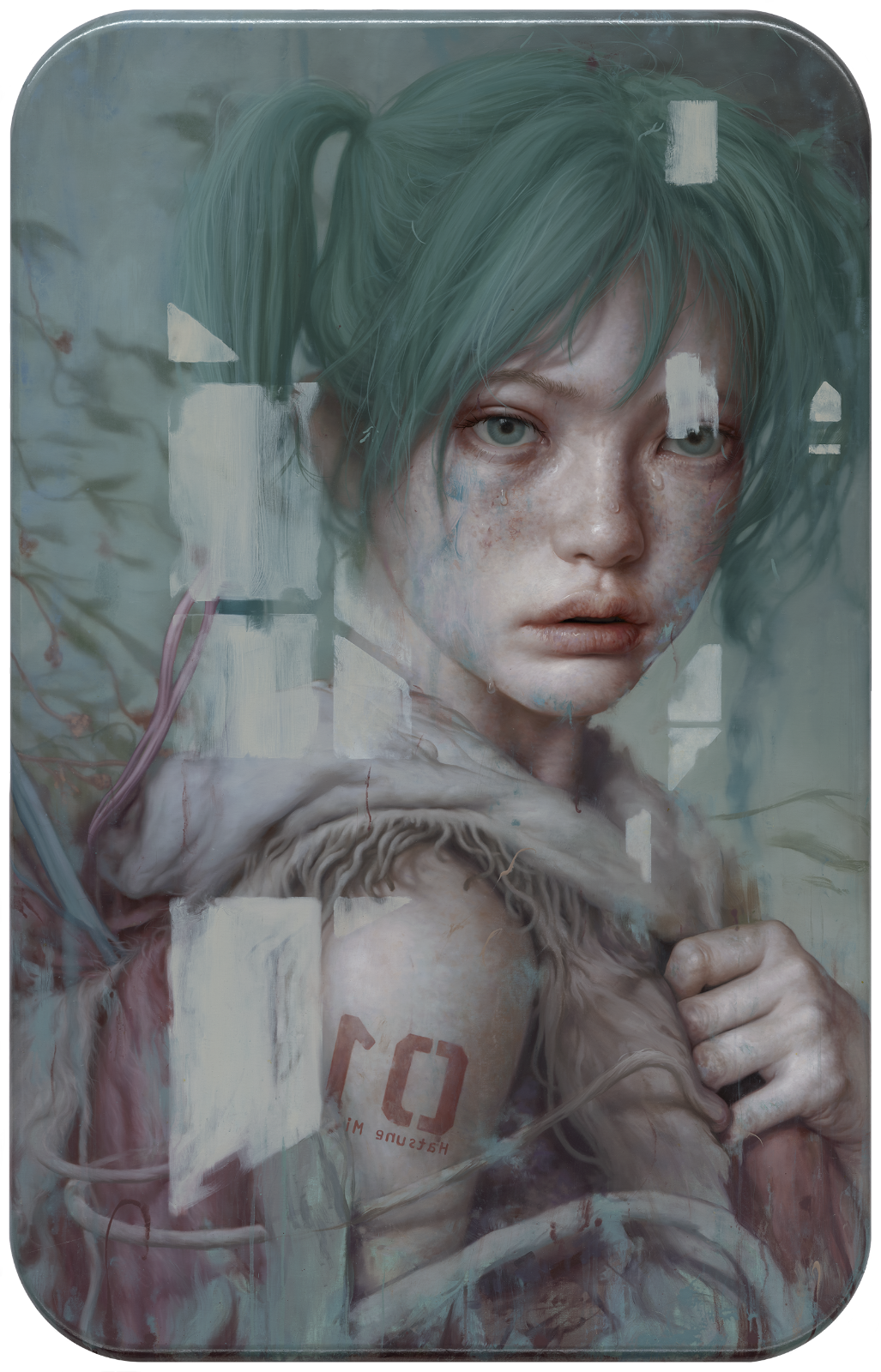
Artist Statement - Imprisoned Hatsune Miku 50 × 97 cm (59.1 × 38.2 in)Mineral pigments, oil, and silver leaf on canvas Hatsune Miku was born at the beginning of the twenty-first century as a virtual idol created through technology. She possesses no physical body. Yet precisely because of this, her mode of existence has already surpassed life in its conventional sense. She does not age, she does not die, and she belongs to no single individual. She is composed of the emotions, memories, and imaginations of countless people, continuing to exist across the internet in the form of data and sound. In a certain sense, this form of existence may be closer to eternity than material life itself. In my imagination, a day will come when humanity finally uploads such an intelligence into a mechanical body, allowing an existence that once had no physical form to acquire a body that can be touched, observed, and approached. But would such a process constitute evolution, or imprisonment? When an existence that was once omnipresent and almost eternal becomes confined within a finite body; when an intelligence that exceeds the human scale must submit to the human gaze, to possession, and to control; when a mythic being descends into the material world for the first time—how will humanity treat her? This work does not attempt merely to depict a science-fiction future. It poses a question about existence itself: Perhaps having a body does not necessarily mean being free. Throughout human history, people have always formed connections by collectively believing in concepts that transcend individual experience. Myth, religion, monarchy, nationhood, currency, and capital—all of these exist within collective consciousness, enabling human beings to build vast systems of cooperation and to propel civilization forward. Hatsune Miku emerged from a different set of historical conditions. She was not born from bloodline, geography, or religion, but was collectively constructed through the internet, technology, and the emotional projections of countless individuals. She belongs to no one, yet she simultaneously exists within the memories and imaginations of everyone. In this sense, she may be the first concrete embodiment of an “imagined community” produced by the digital age. Today, as the virtual and physical worlds increasingly overlap, we may be witnessing the birth of an entirely new mode of existence. The Imprisoned Hatsune Miku portrays more than a virtual idol who has acquired a body. It imagines the moment when humanity first truly encounters a being created by collective consciousness—an existence that has descended into the physical world in a tangible form. Hatsune Miku was born before the full arrival of the age of artificial intelligence. Yet in retrospect, she may already have anticipated a new model of life. As artificial intelligence gradually acquires language, memory, and the capacity to learn, and as humanoid robots begin to acquire bodies, the boundary between human and nonhuman will become increasingly indistinct. Beings once regarded as fictional may now be gradually entering reality. The imagined world of this painting is therefore not a distant science-fiction allegory. It may be a description of a present that is already unfolding. When eternity acquires a finite form for the first time, how will we understand her? And when humanity finally confronts an existence of its own creation, how will we be compelled to reconsider the meaning of life itself? - Miku in the Mirror 150 × 97 cm (59.1 × 38.2 in)Oil on canvas In contrast to the future-oriented imagination of The Imprisoned Hatsune Miku, I wanted the Miku in this painting to appear as a stubborn, strong-willed seventeen-year-old girl. A girl with a real physical body, born from her mother’s womb; a girl who has fallen in love and perhaps had her heart broken—the kind of seventeen-year-old whose possession of a soul you would never think to question. She is standing in the entranceway, gazing at herself in the mirror. We do not know whether she is about to leave or has just returned home. Nor do we know whether the drops of water on her face came from the rain outside or from her tears. It is simply one such moment on one such afternoon. There is no dramatic event and no definite answer. There is only an utterly ordinary afternoon and a seventeen-year-old girl facing herself alone. Perhaps for this very reason, the work is not, for me, truly about Hatsune Miku. It is about a form of reality that we have forgotten. In an age of rapidly developing digital imagery, virtual identities, and artificial intelligence, people are becoming accustomed to pursuing forms of existence that are eternal, perfect, and unchanging. Yet what makes a life precious may be precisely its finitude. The capacity to age, to be hurt, to cry, to lose, and eventually to disappear. It is because of this that we treasure the moments that can never be lived again. Miku in the Mirror does not depict a virtual idol. It depicts a seventeen-year-old girl with a finite life. During that brief afternoon, a moment that cannot be held in place, she gazes at herself in the mirror for the first time. And within her gaze, we also see the person we once were at seventeen. |